Panacea Africa Healthcare Thought Leadership Series — Part 1 There is a lot of discussion about building hospitals in Africa. More equipment/More specialists. More digital health projects/More funding. All of these matter. But after spending time looking at healthcare systems across Africa, I increasingly believe the bigger question is:
Panacea Africa Healthcare Thought Leadership Series — Part 1
There is a lot of discussion about building hospitals in Africa.
More equipment/More specialists.
More digital health projects/More funding.
All of these matter.
But after spending time looking at healthcare systems across Africa, I increasingly believe the bigger question is:
Are we building healthcare capacity — or simply adding more healthcare projects?
The distinction is important.
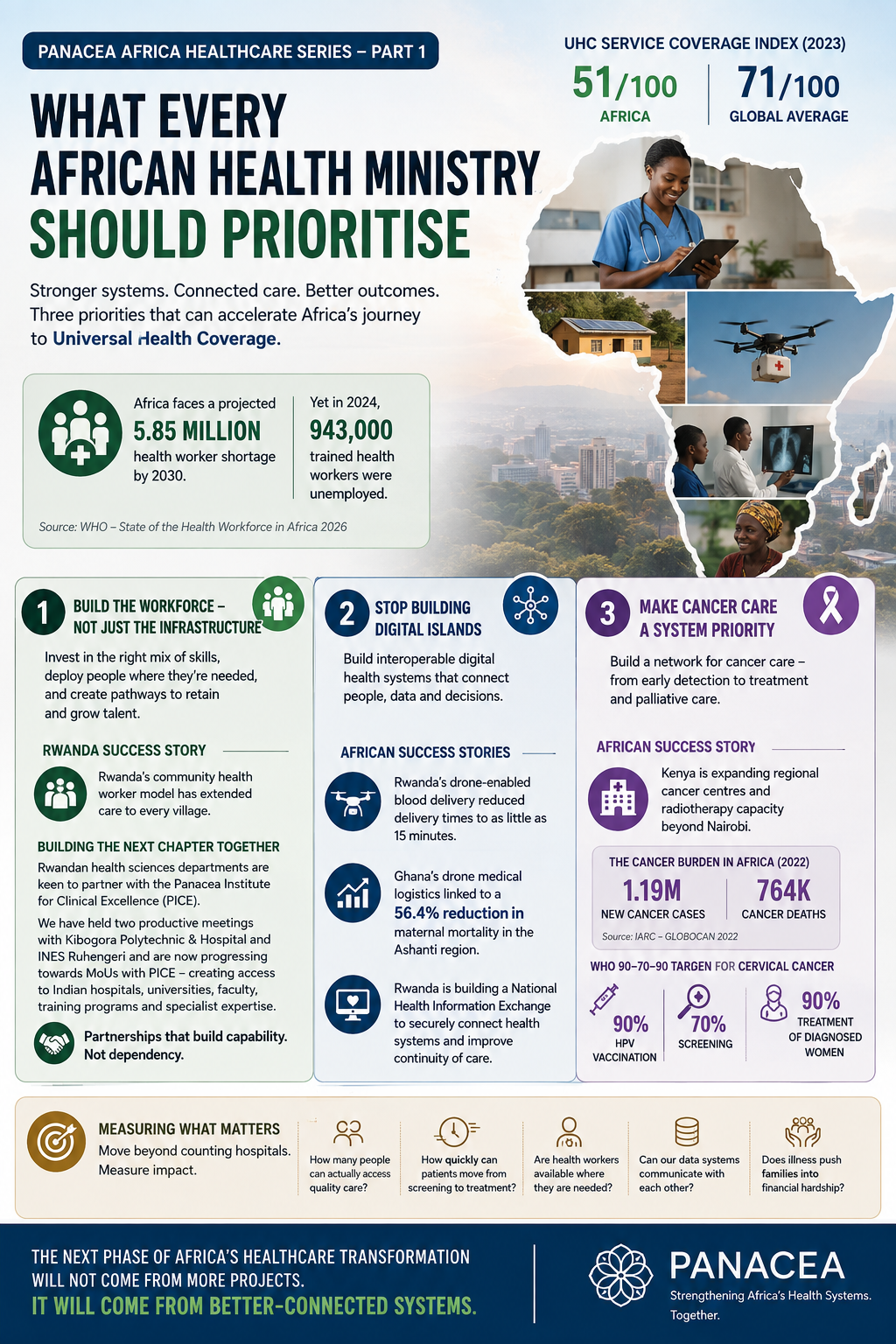
Africa has made real progress towards Universal Health Coverage. But the latest WHO data puts the UHC Service Coverage Index for the African Region at 51 out of 100, compared with a global average of 71.
And behind that number are three structural priorities that, in my view, deserve much greater attention from Health Ministries.
1. Build the workforce — not just the infrastructure
Africa does not have only a "doctor shortage".
It has a health workforce planning, employment, distribution and retention challenge.
WHO's 2026 assessment estimates that the African Region could still face a needs-based shortage of approximately 5.85 million health workers by 2030.
But there is another striking part of the story.
In 2024, an estimated 943,000 trained health workers were unemployed, even while health systems remain understaffed.
So the answer cannot simply be:
Train more doctors.
We need to ask:
Are we training the right skills?
Can the health system employ them?
Can we retain them?
Can we get them to underserved areas?
Can technology extend their reach?
Can African institutions work with international partners to build specialist capacity locally?
These questions are at the heart of the workforce challenge.
And there are African examples worth learning from.
- Rwanda's community health worker model has demonstrated how investing in a structured community-level workforce can extend primary healthcare deep into communities. Rwanda deployed over 58,000 salaried CHWs across villages. Trained to diagnose and treat childhood illnesses, monitor maternal health, and provide rapid triage, this workforce contributed significantly to reducing maternal mortality by over 70% in two decades.
Rwanda has also progressively strengthened the connection between community health workers, health posts and higher-level facilities.
The lesson is not simply "have more community health workers."
It is:
Build a workforce architecture in which every level of the health system has a defined role and a clear connection to the next.
Rwanda is an interesting example of where Africa's healthcare transformation can go next.
The country has already demonstrated what is possible through strong primary healthcare systems, community health programmes, digital health infrastructure and innovative medical logistics.
But the next challenge is deeper:
How do you build the specialist and academic capacity needed to sustain the system?
This is an area where we are beginning to see a very interesting development ourselves.
Health sciences departments and healthcare institutions in Rwanda have shown strong interest in building structured academic and clinical partnerships with the Panacea Institute for Clinical Excellence (PICE).
We have already had two very encouraging discussions — with Kibogora Polytechnic and Kibogora Hospital, and with INES Ruhengeri — around how Rwandan health sciences institutions can connect more systematically with India's healthcare ecosystem.
We are now progressing towards MoUs with PICE, creating a framework through which these institutions can access Indian hospitals, universities, specialists, faculty, training programmes and clinical expertise.
The ambition is not simply to send students or doctors abroad.
It is to create institution-to-institution bridges.
Indian specialists supporting teaching and clinical training in Rwanda.
Rwandan faculty and students gaining exposure to specialised clinical environments in India.
Joint academic and research opportunities.
Clinical mentorship and specialist networks.
And, where appropriate, connecting Rwandan institutions with Indian hospitals and universities to help develop new areas of clinical capability.
This is particularly relevant because Rwanda itself is pursuing an ambitious expansion of its health workforce through the 4x4 reform, which aims to quadruple the country's health workforce over four years and explicitly recognises the need for partnerships, visiting faculty and stronger training capacity.
There is an important principle here:
International partnerships should not create dependency. They should create capability.
The goal should be to progressively strengthen the institution on the ground — its people, its teaching, its clinical services, its research and its connections.
That, in our view, is what a meaningful India–Africa healthcare partnership should look like.
And Rwanda may offer an important blueprint for how this can be done.
2. Stop building digital islands
Africa has some genuinely impressive digital health innovations.
But there is also a familiar problem:
Pilotitis.
One application here.
One EMR there.
Another platform for laboratories.
Another for pharmacies.
Another national reporting system.
More technology does not automatically mean a more intelligent health system.
The real prize is interoperability.
Patient information should move securely between the appropriate parts of the healthcare system.
Laboratory data should be usable by clinicians.
Medicine availability should be visible.
Referral pathways should be trackable.
Ministries should be able to turn health data into decisions.
And systems must work in the real-world African context — including facilities with unreliable connectivity.
There are already examples of what this can look like.
Rwanda has been developing a National Health Information Exchange designed to allow secure and interoperable exchange of health information across different health information systems.
And Rwanda's use of technology goes beyond software.
Its national blood service has used drone logistics to reach remote facilities, reducing delivery times in some cases from hours to around 15 minutes.
In Ghana, drone-enabled medical logistics have also been linked to measurable health outcomes. A study of facilities served by the system in the Ashanti Region reported a 56.4% reduction in maternal mortality compared with facilities not served by the system.
These examples are important because technology was not introduced simply because it was innovative.
It was introduced to solve a specific health-system problem:
How do we get the right medical product to the right facility quickly?
That is the kind of digital transformation worth pursuing.
3. Make cancer care a health-system priority
Cancer is becoming one of Africa's defining healthcare challenges.
IARC estimates that Africa recorded approximately 1.19 million new cancer cases and 764,000 cancer deaths in 2022.
Yet in many countries, screening, pathology, surgery, chemotherapy and radiotherapy remain concentrated in a small number of centres.
The result is predictable:
Late diagnosis.
Long journeys.
Delayed treatment.
Higher costs.
Poorer outcomes.
The solution cannot simply be to build one large oncology hospital in the capital.
We need a network of cancer care.
Primary-care screening.
Diagnostic and pathology capacity.
Regional treatment centres.
Chemotherapy closer to patients.
Strong referral pathways.
Specialist oncology hubs for complex cases.
Tele-oncology and clinical connectivity where specialists are scarce.
Again, there are lessons within Africa.
Kenya has been pursuing a regional approach to cancer services, including regional cancer centres and expansion of radiotherapy capacity beyond Nairobi.
The underlying principle is exactly the one we should be discussing more widely:
Specialist healthcare should not have to mean centralised healthcare.
The bigger lesson from these African examples
Rwanda's community health workforce.
Rwanda's digital health architecture and drone-enabled blood delivery.
Ghana's use of technology to strengthen medical logistics.
Kenya's move towards regional cancer capacity.
These are not identical projects.
But they share something important.
They start with a health-system problem and then use policy, people, infrastructure, partnerships and technology to solve it.
That is very different from starting with a technology and asking:
"Where can we use this?"
And perhaps this is where the next phase of Africa's healthcare development needs to go.
Not:
More projects.
But:
Better-connected systems.
What should Health Ministries measure?
Perhaps we need to move beyond:
"How many hospitals did we build?"
And ask:
How many people can actually access quality care?
How quickly can a patient move from screening to diagnosis to treatment?
How many trained health workers are available where they are needed?
Can our health information systems communicate with each other?
Can essential medicines and blood reach remote facilities when they are needed?
How much does serious illness push a family into financial hardship?
These are much closer to what Universal Health Coverage actually means.
WHO's data tells us that Africa has moved forward — but progress has slowed.
The next phase will require something more difficult than individual projects.
It will require system integration.
Where does Panacea fit into this?
This is the space we are increasingly trying to work in through the @PanaceainstituteforClinicalExcellence.
Not simply bringing individual patients to India.
Not simply supplying technology.
Not simply arranging doctors.
But helping connect African healthcare needs with practical implementation capabilities.
That can mean:
Workforce & Clinical Capacity — connecting African institutions with Indian hospitals, specialists, faculty, training programmes and clinical networks.
Digital Health Infrastructure — supporting connected healthcare systems, telemedicine, AI-enabled solutions, clinical connectivity and health-data infrastructure.
Specialist Care & Centres of Excellence — helping hospitals develop capabilities in areas such as oncology through phased and sustainable models.
And where advanced treatment is not yet available locally, our medical tourism platform can provide a bridge to specialised care in India — while the longer-term objective remains strengthening local capacity.
For us, the opportunity is not:
India replacing African healthcare.
It is:
India and Africa building stronger healthcare systems together.
That is a very different proposition.
And this is only Part 1.
In Part 2 of the Panacea Africa Healthcare Thought Leadership Series, we will go deeper into perhaps the most fundamental issue of all:
Africa's Health Workforce — Why "Train More" Is Not Enough.
I would be interested to hear from Health Ministers, policymakers, hospital leaders and healthcare professionals across Africa:
What should governments, development partners, private healthcare organisations and international institutions do differently to help deliver them?
Sumiit Gupta
Panacea Healthcare Group
+91-9958800961
www.panaceamedcare.com
#AfricanHealthcare #UniversalHealthCoverage #AfricaHealth #DigitalHealth #HealthWorkforce #CancerCare #HealthcareInfrastructure #IndiaAfrica #HealthSystems #Panacea